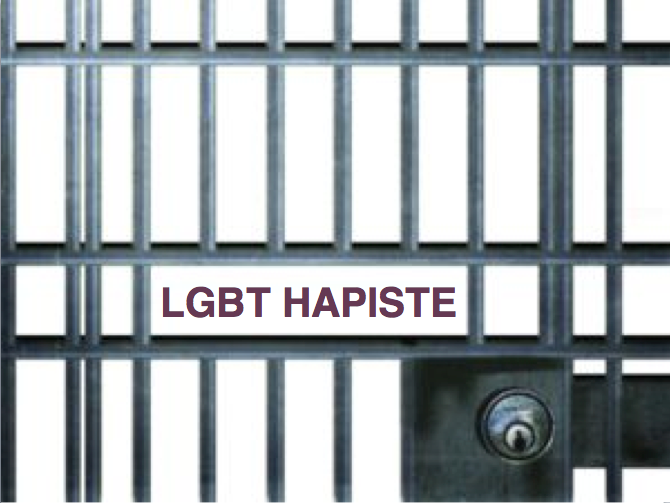
Source: Elif Avcı, “Türkiye’de LGBT Mahpus Olmak,” (“To be an LGBT inmate in Turkey,”) bianet, 7 September 2013, http://www.bianet.org/biamag/diger/149703-turkiye-de-lgbt-mahpus-olmak
Even if it seems like we are all equal before the law, certain groups are outside of that equality in comparison to others. Prisons must develop new strategies to ensure that LGBT inmates serve their sentences in conditions compatible with human dignity.
Gender diversity as a human trait and sexual orientation as a formation that develops either naturally or by choice, have extensive social and political realities which cannot be squeezed into individual and moral contexts.
Just as any reality that is “othered” as a taboo in society needs political and public advocacy, it also needs to be legally secured and the foundations of social, political, and cultural acceptance must be laid out with rights and obligations.
The roots of this demand from the state and from its legal basis i.e. the constitution are human dignity and the universality of human rights.
Just as human rights do not vary from person to person, country to country, and culture to culture, human rights possess an equality, a universality and a validity that does not vary according to the diversity of gender or sexual orientation either. Despite the fact that Turkey’s legal framework recognizes this reality, in practice Turkey is “guilty” of not bringing these given rights and liberties into reality and of not protecting human rights and dignity as a universal principle.
According to the Regulation on the Administration of Penal Institutions and the Execution Of Penalty and Security Measures; “the rules regarding the execution of sentences and security measures are enforced without discrimination and without granting any privileges to anybody based on their race, language, religion, sect, nationality, color, gender, birth, philosophical beliefs, national or social origin, political or other opinions, economic power or any other social position. [1]
Cruel, inhumane, humiliating or degrading behaviors cannot be used in the execution of sentences and security measures.” [2]
In other words; anyone deprived of their freedom in prison is equal. You cannot be privileged no matter what your skin color, nationality, religion or gender is. Even though the expressions “sexual orientation” and “gender identity” are not included in this text, sexual orientation or gender identity cannot be a cause of discrimination in prisons because we are all equal before the law according to the 10th Article of the Turkish Constitution. Besides, according to the the Yogyakarta Principles on the Application of International Human Rights Law in Relation to Sexual Orientation and Gender Identity “Everyone deprived of liberty shall be treated with humanity and with respect for the inherent dignity of the human person. Sexual orientation and gender identity are integral to each person’s dignity.” [3] However in real life, especially in prisons where we are deprived of our freedom, are we really as equal as we are on paper?
Lesbian, Gay, Bisexual, Transgender inmates encounter difficulties similar to other inmates. However, because of the prejudice against their sexual orientation or gender identity, they may have additional problems when compared to others. By means of the reports prepared by international and local human rights associations in Turkey, rights violations that take place in prisons can be detected and suggestions can be made for the resolution of these violations. Yet when the subject is LGBT people, you cannot even get information on the exact number of inmates, let alone rights violations. [4]
Other than Kaos GL’s Human Rights Report and the Civil Society in the Penal System Foundation’s Handbook on Inmates with Special Needs, finding Turkish resources on this topic is not easy. Even in Europe very few documents on the special needs of LGBT people can be found. Nevertheless, the awareness of LGBT inmates’ special needs is increasing gradually all around the world and particularly in the USA, and governments have started to shape their justice systems in light of this information.
The Regulation on the Administration of Penal Institutions and the Execution Of Penalty and Security Measures states; “The execution of sentences and security measures’ main purpose is first, providing general and individual prevention, with that intent consolidating the factors that prevent the convict from committing a crime again, protecting society from crime, encouraging the convict to reintegrate, and easing the convict’s adaptation to a lifestyle that is productive, responsible and respectful of the law and social rules.” [5]
Additionally, “international human rights organizations mandate that states must protect all inmates under supervision and care and must help them reintegrate into society. The extreme vulnerability of LGBT people in the criminal justice system requires generating policies in order to meet the needs of this group, providing special social reintegration tools, and applying new strategies in order to prevent them from being aggrieved in prisons again.” [6]
Most LGBT inmates choose to hide their sexual orientation or gender identity due to the fear of exclusion and discrimination. This is why the exact number of LGBT people in prisons cannot be calculated. However, most of the time it is not possible to keep it hidden from fellow inmates they may spend years with. The situation gets even more problematic for trans people who are unavoidably visible and who may have transformed their bodies.
This article aims to make visible the different needs of LGBT inmates and how these needs are addressed by the present rules/practices. Providing this visibility is significant because as long as the special needs of LGBT people in prison remain unknown, the development of policies intended to meet these needs will be prevented.
Because the Ministry of Justice has not formulated any solutions, wardens and guardians do not know how to act when they encounter an LGBT person. That is why this article will contain two different parts. The first part will discuss the kinds of problems LGBT inmates encounter during admittance, classification, nutrition, clothing, accommodation, rehabilitation, and preparation for release. The second part will suggest solutions to the problems faced during these phases.
“Special” Needs From Admittance to Release
Being a prisoner is a process that consists of many phases from admittance and registration to getting released. LGBT people are already exposed to homophobia, transphobia, and biphobia in their civilian lives. As they go through the phases of prison life which restrict their liberty, they face rights violations that are caused by society’s homophobia and transphobia, and sometimes just because of a lack of knowledge.
Being a prisoner starts with admittance to the institution. The first and last names of the convicts, the crime they committed, the duration of their sentence, date and number of the sentence, and the starting date of the jail time are recorded in the “convict registration book.” The rotation number given during recording becomes the number of the convict. After that point, the first crisis arises. According to the regulation, the convict must now be body searched, his/her fingerprints, palm prints, and photograph must be taken, blood type, body features and body measurements must be described.[7] But who is going to conduct the body search and how?
Should the body search be conducted by someone who holds the same color identification card or should it be conducted according to the convict’s declaration of his/her own gender? When we look at the execution of this procedure, we see that these searches, which are repeated frequently for one reason or another, are conducted by a person who holds the same color identification card as the convict.
“We were brought to an L1 type prison. We were lined up. We were kept waiting outside for an hour. After the first entrance, a male soldier on watch searched me in the middle of everyone. I can say that I was harassed by hand. After that when we entered the building they took me to a room by myself. But everybody could see in through the window if I did not object. There were three soldiers. They told me to take my clothes off so I asked to be searched by a female personnel, there was a female officer there. They refused. They said they were going to search me themselves because I was recorded as a man on my identification card. When they told me to take my clothes off once more I said that I could not take my clothes off in front of three people. Then they snapped at me harshly but after the discussion, just one of them stayed in the room and he wanted me to get entirely naked. He forced me to take my underpants off. He advanced towards me so I took them off. Then he made me sit down and get up and even searched my hair. They told me to put my clothes on and kept me waiting, saying that they will deliver me to the guardians. Their mocking behavior continued in the meantime. Then I was again taken into a small room to be delivered to a guardian. There were two of them and they asked me to take my clothes off again. I protested but both of them stayed, they made fun of my breasts, they watched me take off my clothes, mocking me saying “you look like a broad.” After I got naked they searched me with their hands, I think that was harassment. They laughed saying “why didn’t you have this cut off?” Then I put my clothes on and started towards the inside of the prison. At the entrance they made me take my shoes off etc.” [8]
LGBT inmates can also be subjected to homophobia and transphobia by prison doctors or by the doctors of the hospitals they are taken for health controls.
“The next day procedures like photos and hospital visits started. These were traumatic situations as well. Whenever I entered a room I was harassed by the snickering of doctors or by stares because I am transsexual. That was suffocating and when I told the doctor that I am transsexual and that I was kept in a one person cell and that I did not feel good, the doctor told me he was going to “perform an anal examination by finger.” I said “what do you mean?” Soldiers were there looking at us and the doctor was telling me to “take position, I want to perform an anal examination on you.” He put on gloves, it was a horrible experience for me, I was sweating heavily and then he turned to me and said: “No, you have never had intercourse.Therefore you are going to be kept by yourself.” Then I put my clothes on among the soldiers. You can resist a certain amount but after a point you just think they can do whatever, I do not care how much time I am going to do in jail, I just want this torture to end.” [9]
After the first controls and recording comes the classification of the convict. According to Article 26 of the classification chapter in the second section of the Regulation of Observation and Classification Centers[10] under the title of “grouping based on mental and physical conditions,” convicts are grouped as “ones who have different sexual orientations.” Again, according to the Regulation on the Administration of Penal Institutions and the Execution Of Penalty and Security Measures, “convicts with different sexual orientation are housed in different places from others.” [11] Although these clauses are significant and rare in recognizing sexual orientation in Turkish legislation, the actual practice reveals that what is framed as sexual orientation actually implies gender identity.
Classification has a vital importance for an LGBT convict. According to the results of the National Transgender Discrimination Research, conducted with 6,500 transgender people or people who are gender non-conforming and published in 2011 by the American National Transgender Equality Center, 38% of the participants who have done jail time were harassed by other inmates and 39% of them were harassed by the prison personnel. [12]
In addition; 16% of the participants stated that they were physically assaulted and 15% of them were sexually assaulted during their time in prison. [13]
While there is no statistical data on Turkey regarding this topic, the information about the current situation is based on LGBT people’s experiences, which they shared with NGOs. At the moment, there are 3 prisons in Turkey which have separate wards for trans women: Sincan F type high security closed penal institution, Maltepe L type closed penal institution, and Çorum L type closed penal institution. It is said that approximately 70 trans women are in these prisons. [14] When we look at other prisons, we see that trans people who have changed the color of their identification cards after sex reassignment surgeries stay with people who have the same color identification or by themselves if an empty ward is available.
“Then they put me in a one person cell, there was a concrete bed with a dirty mattress on top of it and a brown, crested blanket on the bed. The toilet is separated by just a wall. They tell you to live surrounded by a disgusting smell, I was totally depressed. I started to think that this experience was dehumanizing me. I stopped eating, death was the only salvation at that point. I did not eat for 7 or 8 days, the psychologist and the director would come to convince me, I was reading the writings of the previous inmates on the walls, there was nobody I could reach. The only people I could reach were my family and I was writing to them about my situation. If you reveal too much in your letters, they say they will not send it. They told me to write a letter just asking how they were. Then the prosecutor saw the seriousness of the situation. They told me to “get up” when he came to visit, I was exhausted and I was stumbling, the man was looking into my eyes but I could not say anything. I just wept. I could not say “this is my situation, is this humane?” I was just crying. Then he said “Put this [person] in a ward” and I was hastily placed in a ward on that day.” [15]
After classification, another problematic area for LGBT inmates is the rehabilitation programs. According to the Regulation on the Administration of Penal Institutions and the Execution Of Penalty and Security Measures, “Rehabilitation is a group of programs that last from admittance to release in order to maintain or regain their physical and mental health, to overcome feelings of guilt, to provide services of education, health, psycho-social, individualization, and employment for the convict’s harmonization into society.” [16]
However, LGBT inmates are often deprived of these activities with the excuse that their security cannot be ensured. Because most of them have broken their connections with their first degree relatives, they are not visited by their families. Because same-sex marriages are not recognized, they cannot get to benefit from the chances to see their life partners. When you add staying in a one-person ward or cell to that equation, this isolated life has serious and severe effects on the convict’s life.
“I realized that isolation has serious negative reflections in people’s lives, keeping someone in a one-person ward or cell serves to leave them without people, without honor. I can say, with all my heart, that isolation is a crime against humanity, no matter the crime that has been committed or who committed it.” [17]
Trans people, deprived of their liberty in prisons, may have to do without hormone therapies, that must be used regularly, or sex reassignment surgeries. Most convicts cannot even access gender identity related goods let alone continue the sex reassignment process they started before entering prison. Furthermore, it is hard to access LGBT themed books and magazines because of discipline committee bans.
According to the Regulation on the Administration of Penal Institutions and the Execution Of Penalty and Security Measures, a process of preparation for release starts near the convict’s date of release. “Precautions are taken to prompt convicts to think about their futures, they are encouraged and aided to contact official or private individuals or institutions for their adaptation to society and for the benefit of their family.”[18]
However, when the subject matter is LGBT people this clause can also be overlooked. As a result of this, convicts who have cut their connections with society because of isolation or other reasons during their sentence have severe difficulties in social reintegration.
Solution Suggestions and Good Examples
1) Changes in regulations and bylaws: The addition of “gender identity” along with “sexual orientation” to the guidelines of regulations that classify convicts in the the Regulation on the Administration of Penal Institutions and the Execution Of Penalty and Security Measures and the Regulations of Observation and Classification Centers.
2) Information Systems: Rather than using the dual system of “man”- “woman” through identification colors, entering information according the person’s own declaration.
3) Penal Institution Personnel: The addition of the subjects of sexual orientation and gender identity, as well as the International Human Rights standards on discrimination into the education curriculum of personnel. The inclusion of personnel with different sexual orientations and gender identities.
4) Access to Justice: The addition of information on access to legal aid to be included in the briefing during admittance to facilities. The inclusion of the contact information of institutions that work with LGBT inmates.
5) Body Searches: Allowing LGBT inmates to choose the gender of the personnel conducting body searches.
Good Example: The practice of allowing LGBT inmates to choose the gender of the personnel conducting body searches is accepted by Colombia National Police and New York Children and Family Services. A similar approach is in place in the London Metropolitan Police and many other institutions in the United Kingdom.
6) The Choice to Come Out/Not to Come Out: The choice of sharing sexual orientation and/or gender identity to be left up to the inmate.
7) Accommodation: To increase the number of prisons with LGBT wards. Quality to be as important as quantity.
8) Classification: Paying attention to the inmates’ wishes in accommodation rather than biological gender/identification color. To not house LGBT inmates with inmates who may pose security threats to them in the same wards.
9) Security: A policy of zero tolerance to harassment and assault must be developed and personnel must be educated in the procedures to follow after harassment and assault. To develop an accessible complaint mechanism for inmates.
10) Health: To ensure that LGBT inmates can continue hormone therapies in prison. To open up the path to complete sex reassignment if the therapy is interrupted upon entering prison.
Good Example: In 30 states in the United States of America, transgender individuals have the right to continue hormone therapies “within existent and acceptable care standards.”
11) Access to Gender Identity Related Goods: To ensure LGBT inmates’ access to gender identity related paraphernalia.
12) Visitors: To allow same-sex partners to have conjugal visitation rights without the provision of marriage. Taking into consideration that LGBT inmates may have severed ties with their families, granting the same visitation rights of relatives to friends that the inmate designates.
Good example: In Brazil’s prisons, the majority of inmates have the right to conjugal visits without the provision of marriage.
13) Access to Rehabilitation Programs: To ensure the participation of LGBT inmates in all events open to inmates without discrimination. Taking into consideration that LGBT inmates may not have benefited from their rights to education and work outside due to discrimination, programs in work and education should be galvanizing.
14) Access to LGBT Literature: To prevent the ban of publications with LGBT contents by the discipline board.
15) Preparation for Release and Support after Release: To ensure the communication between LGBT inmates and relevant NGOs before release. To cooperate with social services to ensure the person’s housing and employment.
Instead of a Conclusion
Even though we are all equal before the law according to regulations and bylaws, some groups are kept outside of the bounds of equality. Several reports have been published about rights violations in prisons, which are closed boxes where it is difficult to understand what goes on inside. However, even within these reports, the rights violations that LGBT inmates face in prisons are largely invisible. The number of LGBT inmates in Turkey’s prisons is unknown.
We learn about the problems LGBT inmates face in prisons through the reports of NGOs that work in the field and through witness testimonies. When we look at the world in general, the literature on LGBT inmates in prisons is limited and coming across Turkish works regarding Turkey is almost impossible. Therefore, it is necessary to pay attention to the rights violations LGBT inmates in prisons face, to create awareness about the kinds of discrimination LGBT inmates face during the penalty process, and to produce solutions in this field.
First of all, the work to take preventive measures against the discrimination of LGBT inmates and the prevention of violence, as well as the efforts to institute protective policies without delay, requires the relevant ministries and institutions to be transparent. Reports published across the world reveal that administrations of Penal Institutions must develop strategies that will ensure the humane treatment of inmates during their incarceration and that will allow the reintegration of these groups into society.
[1] Official Gazette of Turkey. 6 April 2006.
[2] Article 4 in the Regulation on the Administration of Penal Institutions and the Execution Of Penalty and Security Measures
[3] Article 9 in International Commission of Jurists, “The Yogyakarta Principles: Principles on the Application of International Human Rights Law in Relation to Sexual Orientation and Gender Identity,” March 2007. http://www.yogyakartaprinciples.org/index.html
[4] According to the Civil Society in the Penal System Foundation’s (CISST) application submitted to Ministry of Justice within the context of the Law on the Right to Information and answered on 24 July 2013, there are 79 LGBT inmates in 18 different prisons. However, as CISST states, this number reflects trans inmates who are visible and not all LGBT inmates.
[5] Article 4 in the Regulation on the Administration of Penal Institutions and the Execution Of Penalty and Security Measures
[6] Handbook on Prisoners with Special Needs, p. 104
[7] Article 67 in the Regulation on the Administration of Penal Institutions and the Execution Of Penalty and Security Measures
[8] Kaos GL, “LGBT Bireylerin İnsan Hakları Raporu.” (“Human Rights Report on LGBT People”) 2008, p. 44.
[9] Kaos GL, “LGBT Bireylerin İnsan Hakları Raporu.” (“Human Rights Report on LGBT People”) 2008, p. 43.
[10] Official Gazette of Turkey, 25848, 17 June 2005
[11] Article 69 in the Regulation on the Administration of Penal Institutions and the Execution Of Penalty and Security Measures
[12] National Center for Transgender Equality ve National Gay and Lesbian Task Force, “Injustice at Every Turn: A Report Of the National Transgender Discrimination Survey,” 2011, p. 166.
[13] ibid, 167.
[14] Çiçek Tahaoğlu, “Homofobi Hem İçeride Hem Dışarıda” (“Homophobia is both inside and outside.”) 17 May 2012.
[15] Kaos GL, “LGBT Bireylerin İnsan Hakları Raporu.” (“Human Rights Report on LGBT People”) 2008, p. 41.
[16] Article 101 in the Regulation on the Administration of Penal Institutions and the Execution Of Penalty and Security Measures
[17] Kaos GL, “LGBT Bireylerin İnsan Hakları Raporu.” (“Human Rights Report on LGBT People”) 2008, p. 42.
[18] Article 135 in the Regulation on the Administration of Penal Institutions and the Execution Of Penalty and Security Measures
[19] Transgender Law Center, “Preventing the Sexual Abuse of Lesbian, Gay, Bisexual, Transgender, and Intersex People in Correctional Settings,” 10 May 2010, p. 11
[20] Lisa Leff, “U.S Prisons Officials OK Hormone Treatments For Trans İnmates,” 06 October 2011
[22] Latin American Herald Tribune, 07 December 2011
BIBLIOGRAPHY:
– United Nations Office on Drugs and Crime. “Chapter 5: Lesbian, Gay, Bisexual and Transgender (LGBT) Prisoners.” In Handbook on Prisoners with Special Needs. 103-122. New York: United Nations, 2009.http://www.unodc.org/documents/justice-and-prison-reform/Prisoners-with-special-needs.pdf
– National Center for Transgender Equality ve National Gay and Lesbian Task Force. “Injustice at Every Turn: A Report Of the National Transgender Discrimination Survey.” 2011.http://www.thetaskforce.org/downloads/reports/reports/ntds_summary.pdf
– Kaos GL. “LGBT Bireylerin İnsan Hakları Raporu.” (“Human Rights Report on LGBT People). 2008
– Latin American Herald Tribune, 07 December 2011.http://laht.com/article.asp?ArticleId=404257&CategoryId=14090 Accessed: 09 May 2013
– Leff, Lisa. “U.S Prisons Officials OK Hormone Treatments For Trans Inmates.” 06 October 2011. http://www.dallasvoice.com/u-s-prisons-officials-hormone-treatments-trans-inmates-1091438.html Accessed: 09 May 2013
– Leach, Donald L., II. “Managing Lesbian, Gay, Bisexual, Transgender, and Intersex Inmates: Is Your Jail Ready?” LJN Exchange, Annual Issue (2007): 25-30.
– Türkiye Ceza İnfaz Kurumlarının Yönetimi İle Ceza Ve Güvenlik Tedbirlerinin İnfazı Hakkında Tüzük. (The Regulation on the Administration of Penal Institutions and the Execution Of Penalty and Security Measures.) 06 April 2006.http://www.tbmm.gov.tr/komisyon/insanhaklari/belge/um_cezayonetimveguvenliktedbirleri.pdf
– “Preventing the Sexual Abuse of Lesbian, Gay, Bisexual, Transgender, and Intersex People in Correctional Settings”. Washington: National Center for Transgender Equality; San Francisco: National Center for Lesbian Rights; New York: American Civil Liberties Union; San Francisco: Transgender Law Center; New York: Lambda Legal. 10 May 2010.http://www.nclrights.org/site/DocServer/PREA_Standards_Comments_-_ACLU__Lambda__NCLR__NCTE__TLC_.pdf?docID=7542
– Squires, Nick. “Italy opens first prison for transsexuals” 28 January 2010.http://www.telegraph.co.uk/news/worldnews/europe/italy/7092137/Italy-opens-first-prison-for-transsexuals.html
– T.C Ceza İnfaz Kurumları Gözlem ve Sınıflandırma Merkezleri Yönetmeliği. (Regulation of Observation and Classification Centers.) 17 June 2005.http://mevzuat.basbakanlik.gov.tr/Metin.Aspx?MevzuatKod=7.5.8346&MevzuatIliski=0&sourceXmlSearch=G%F6zlem%20ve%20S%FDn%FDfland%FDrma%20Merkezleri%20Y%F6netmeli%F0i
– Tahaoğlu, Çiçek. “Homofobi Hem İçeride Hem Dışarıda.” (“Homophobia is both inside and outside.”) 17 May 2012.http://bianet.org/bianet/bianet/138411-homofobi-hem-iceride-hem-disarida
– Ceza İnfaz Sisteminde Sivil Toplum Derneği. “Adalet Bakanlığı’ndan LGBT Mahpsulara İlişkin Başvurumuza Cevap Var.” (“Ministry of Justice responds to our Petition Regarding LGBT Inmates.”) http://www.cezaevindestk.org/duyuru-75-adalet_bakanligi%E2%80%99ndan_lgbt_mahpuslara_iliskin_basvurumuza_cevap_var
– International Commission of Jurists. “The Yogyakarta Principles: Principles on the Application of International Human Rights Law in Relation to Sexual Orientation and Gender Identity.” March 2007. http://www.yogyakartaprinciples.org/index.html
*Source: LGBT News Turkey, http://lgbtinewsturkey.com/2013/09/13/to-be-an-lgbt-inmate-in-turkey/